
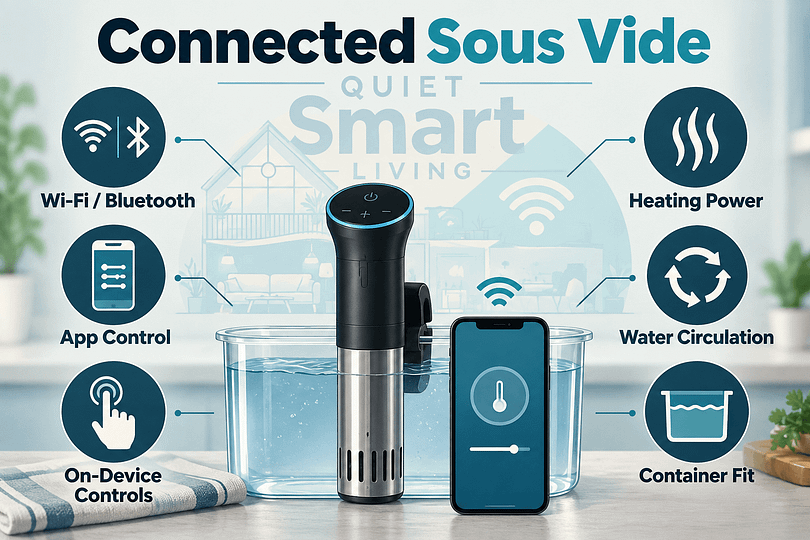
Connected sous vide machines can make long, low-temperature cooking easier to manage, but the Wi-Fi logo should not be the only reason to choose one. The fundamentals still matter: stable temperature control, useful onboard controls, heating power, container fit, app design, and how much friction the connected features actually remove.
This guide compares four current connected immersion circulators from Anova, Breville, INKBIRD, and Vesta. We also keep the older Anova Nano 2.0 in context for readers looking at legacy stock or a simpler Bluetooth-era model.
How we evaluated them: this is an editorial comparison based on current manufacturer specifications, product documentation, control options, connected features, and practical buyer considerations. We have not represented these products as hands-on tested unless Quiet Smart Living has actually tested them.
Quick comparison
| Model | Power | Connection | Control style | QSL fit |
|---|---|---|---|---|
| Anova Precision Cooker 3.0 | 1100 W | Dual-band Wi-Fi | On-device controls + app | Best all-round connected option |
| Breville Joule Turbo | 1100 W | Connected Breville+ ecosystem | App-led workflow + voice features | Best for app-guided cooking |
| INKBIRD ISV-200W | 1000 W | 2.4 GHz Wi-Fi | On-device display + app | Straightforward Wi-Fi control |
| Vesta Imersa Elite | 900 W | 2.4 GHz Wi-Fi | Touchscreen + Vesta app | Compact connected alternative |
Short version: Anova offers the most balanced combination of direct controls and modern connectivity. Joule Turbo is the most app-centered experience. INKBIRD is a simpler Wi-Fi-first alternative, while the Vesta stands out for its compact flip-display design.
How we compared these sous vide machines
For a connected sous vide cooker, we look beyond whether the box says “smart.” A useful connected model should still work as a dependable immersion circulator first.
The main comparison points are:
- Connectivity: Wi-Fi band, app support, and whether remote monitoring is central to the product.
- Direct controls: whether you can operate the cooker conveniently at the appliance instead of reaching for a phone every time.
- Heating power: higher wattage can help with larger water baths and heat-up speed, although design and circulation matter too.
- Temperature control: the operating range and stated accuracy.
- Water circulation: important for keeping temperatures even throughout the bath.
- Container compatibility: clamp design, minimum water level, body height, and whether the unit works comfortably with shallow or larger containers.
- App dependence: whether connectivity is an optional convenience or a major part of the daily workflow.
Anova Precision Cooker 3.0: best all-round connected option
The Anova Precision Cooker 3.0 is the strongest all-round fit in this group because its connected features do not replace the fundamentals. It combines 1100 watts of heating power with dual-band Wi-Fi, an iOS/Android app, onboard controls, and an 8-liter-per-minute flow rate.
Anova lists a temperature range of 0–92°C (32–197°F) and accuracy of ±0.1°C. The current model is also rated IPX7 and uses an adjustable, detachable clamp.
The important point for QSL is balance. You can use the connected layer when remote monitoring or app control is useful, but the cooker still provides direct controls at the device. That makes it easier to treat the app as an enhancement rather than a requirement for every small adjustment.
Who it suits: buyers who want a current-generation connected cooker without making the smartphone the entire interface.
Breville Joule Turbo: best for app-guided cooking
The Joule Turbo takes a more software-led approach. Its main strength is the Breville+ connected ecosystem, which combines guided recipes, monitoring, notifications, Turbo cooking modes, Primetime flexibility, and voice activation through Google Assistant and Amazon Alexa.
The current BSV600 model is rated at 1100 watts. Its slim body measures about 1.85 × 1.85 × 12.28 inches, and a magnetic base lets it hold to compatible steel or induction-ready cookware without relying solely on a side clamp.
Joule makes the most sense when you actively want the app to guide the cooking process. If you prefer a traditional appliance-first workflow with clearly emphasized direct temperature controls, compare that interaction model carefully against Anova, INKBIRD, and Vesta.
Who it suits: people who value guided recipes, connected cooking workflows, voice features, and a highly app-centered experience.
INKBIRD ISV-200W: straightforward Wi-Fi control
The INKBIRD ISV-200W takes a simpler route. It provides 1000 watts of heating power, 2.4 GHz Wi-Fi, remote monitoring through the INKBIRD app, and a built-in display for local operation.
INKBIRD specifies a 0–90°C (32–194°F) control range, stated accuracy of 0.1°C / 1°F, and timer settings up to 99 hours and 59 minutes.
The appeal here is not a broad connected-home ecosystem. It is a conventional immersion circulator with Wi-Fi layered on top, which may be preferable if you mainly want remote monitoring without a more elaborate cooking platform.
For the full model-specific details, read our INKBIRD ISV-200W review.
Who it suits: buyers who want useful Wi-Fi control but do not need an extensive recipe or voice-assistant ecosystem.
Vesta Imersa Elite: compact connected alternative
The Vesta Imersa Elite approaches the same problem differently. Its compact flip-display design keeps the controls easy to view while allowing the body to fit shallower cooking containers than many taller stick circulators.
The current US SV81-BK specification lists 900 watts, water volume up to 20 liters, a 4.5-liter-per-minute pump, and a working temperature range of 20–95°C (68–203°F). Vesta also specifies 0.1°C accuracy and Wi-Fi control through its app.
The large touchscreen means the connected features are not the only control surface. For buyers who dislike having to reach for a phone for every change, that is an important distinction.
Our existing review goes deeper into setup, app control, water-level protection, and buyer-feedback patterns: Vesta Imersa Elite WiFi Sous Vide Cooker review.
Who it suits: kitchens where compact storage, shallow-container compatibility, touchscreen operation, and remote app access all matter.
Which connected sous vide machine should you choose?
There is no universal winner because the four machines put their connected features in different places.
- Choose Anova Precision Cooker 3.0 if you want the strongest balance of power, onboard controls, dual-band Wi-Fi and app connectivity.
- Choose Breville Joule Turbo if guided cooking, recipes, notifications, voice features and app-driven workflows are the priority.
- Choose INKBIRD ISV-200W if you want a more conventional immersion circulator with straightforward 2.4 GHz Wi-Fi control.
- Consider Vesta Imersa Elite if compact storage, the flip touchscreen and shallow-container compatibility matter more than maximum heater wattage.
For Quiet Smart Living, “smart” should make the appliance easier to live with. A longer feature list does not help if the app adds friction to a job that should be simple.
Wi-Fi vs Bluetooth for sous vide
Wi-Fi and Bluetooth solve slightly different problems.
Bluetooth is useful for nearby phone control without putting the appliance on your home network. Wi-Fi is more useful when you want the cooker connected through your home network for monitoring or control beyond immediate Bluetooth range.
The practical distinction is less about which wireless logo looks better and more about how you actually cook. If you normally set the water bath while standing beside it and rarely check it again, onboard controls may matter more than remote connectivity. If you regularly run long cooks and want to monitor progress elsewhere in the house, Wi-Fi becomes more useful.
Network compatibility matters too. Some connected appliances still require 2.4 GHz Wi-Fi, while newer hardware such as the Anova Precision Cooker 3.0 supports dual-band connectivity.
Do you actually need app control?
No. Sous vide itself does not require an app.
A good immersion circulator needs to heat and circulate water accurately. Connected control is valuable when it adds something practical: remote monitoring, scheduling, recipe guidance, notifications, calibration help, or easier access to long-cook settings.
If you dislike appliance apps, prioritize direct device controls first and treat Wi-Fi as a secondary feature. If you already enjoy guided connected cooking, a platform such as Breville+ may be a stronger reason to choose one model over another.
What about the Anova Nano 2.0?
The Anova Nano 2.0 is still useful context, but it belongs to an older generation of Anova’s connected-cooking lineup. Its Bluetooth-focused design is different from the current Precision Cooker 3.0 approach.
That makes it more useful here as a legacy or value comparison than as Anova’s current-generation representative.
If you are looking at older inventory or want to understand that generation, see our Anova Nano 2.0 review.
Do you need a special sous vide container?
Usually not. Many immersion circulators can clamp or hang onto an ordinary stockpot as long as the water stays within the machine’s operating limits and the container is deep enough for safe circulation.
A dedicated container becomes more useful for long cooks, larger batches, or setups where evaporation is a concern. A fitted lid can reduce water loss and help keep the bath more stable over extended cooking periods.
If you use an Anova-style setup with a compatible Rubbermaid container, our EVERIE Sous Vide Lid review explains the lid and cooker-opening compatibility in more detail.
What to look for before buying a sous vide machine
1. Heating power
Wattage does not tell you everything, but it affects how much heating capacity the cooker has available. It becomes more relevant as container size and water volume increase.
2. Direct controls
Ask whether you can comfortably set temperature and time at the appliance. Even buyers who like apps may not want to unlock a phone for every adjustment.
3. App design
A connected appliance is only as useful as the software experience around it. Look for clear pairing instructions, reliable monitoring, sensible permissions, and features you will actually use.
4. Wi-Fi requirements
Check whether the cooker requires 2.4 GHz Wi-Fi or supports dual-band networks. This can matter during setup on modern mesh and combined-band home networks.
5. Container fit and water levels
Check clamp design, minimum and maximum water levels, and the physical height of the cooker. A compact machine may work more comfortably with shallow containers, while larger baths may put more demand on heating and circulation.
6. Waterproofing and protection
Immersion circulators operate beside hot water for long periods, so waterproof ratings and water-level protection deserve attention. They should not be treated as decorative specifications.
Frequently asked questions
What is the best sous vide machine for app control?
For the broadest balance of direct controls and modern connectivity, the Anova Precision Cooker 3.0 is the strongest all-round fit in this group. Buyers who want a more app-guided workflow may prefer the Breville Joule Turbo.
Can you use a sous vide cooker without Wi-Fi?
Yes. Sous vide cooking does not inherently require Wi-Fi. Models with onboard controls can still perform the basic heating and circulation job without using remote app features.
Is Wi-Fi better than Bluetooth for sous vide?
Wi-Fi is more useful for network-based remote monitoring, while Bluetooth is suited to nearby device-to-phone control. The better option depends on whether you genuinely use remote monitoring during long cooks.
How much power should a sous vide machine have?
There is no single minimum wattage for every kitchen. In this connected group, current models range from 900 to 1100 watts. Container size, water volume, circulation and insulation also influence real cooking performance.
Do sous vide machines make noise?
Yes. They use a pump to circulate water, so some operational sound is normal. Manufacturers do not always publish comparable decibel ratings, which makes exact noise ranking difficult without controlled testing.
Do I need a vacuum sealer?
A vacuum sealer is convenient but is not always essential for every sous vide recipe. The important requirement is keeping food safely sealed from the cooking water using an appropriate food-safe method.
Final verdict
For most connected-kitchen buyers, the Anova Precision Cooker 3.0 offers the strongest balance between traditional appliance controls and modern app connectivity. Breville Joule Turbo is the more distinctive choice when guided recipes and an app-led cooking experience are the attraction rather than simply remote control.
INKBIRD’s ISV-200W remains a practical option for straightforward Wi-Fi monitoring, while Vesta’s Imersa Elite offers an unusually compact format with touchscreen and app control.
The bigger lesson is that connectivity should not distract from the fundamentals. Pick the cooker whose control style, container requirements and connected features fit the way you actually cook—not the one with the longest smart-feature list.