
If you want a quieter range hood, the headline CFM number is not enough. A useful comparison has to separate airflow from sound, distinguish certified figures from marketing claims, and account for the ducting and installation that can make a supposedly quiet hood much louder in a real kitchen.
Our current shortlist covers six different buying situations: a built-in insert, a slide-out hood, a higher-airflow wall hood, a powerful under-cabinet option, a connected smart hood and a premium noise-reduction design. We have deliberately not called any model the “quietest” unless the available evidence supports a like-for-like comparison.
Affiliate disclosure: As an Amazon Associate I earn from qualifying purchases. Product availability and search results can change.
Best quiet range hoods at a glance
| Model | Best for | Airflow evidence | Sound evidence | Evidence basis |
|---|---|---|---|---|
| Broan PM400SS | Quiet built-in insert | 450 Max Blower CFM | 1 sone at normal speed | HVI-certified manufacturer specification |
| Broan EBS1304SS | Slide-out installation | 400 CFM | 1.2 sones at normal speed | HVI-certified manufacturer specification |
| Broan EW4830BLS | Current wall-mounted option | 460 Max CFM | 1.5 sones normal; 7.5 sones high | HVI-certified manufacturer specification |
| Hauslane PRO500 | High-airflow under-cabinet use | 550 laboratory CFM; 1,000 equivalent airflow claimed | 1.5–6.0 sones | Manufacturer specification |
| Samsung Bespoke NK30CB700WCGAA | Smart-home automation | Up to 630 CFM | Low-noise claim; no comparable sone figure used here | Manufacturer specification |
| Falmec Plane NRS | Premium noise-reduction design | 600 CFM US variant | NRS noise-reduction technology; no comparable sone figure used here | Manufacturer specification / technology claim |
How we chose these range hoods
We use an evidence hierarchy rather than treating every number on a product page as equivalent. Independent or certified performance evidence sits above ordinary manufacturer specifications. Manufacturer specifications are still useful, but we label them as such. Calculated or derived comparisons are identified separately, and missing information stays missing rather than being guessed.
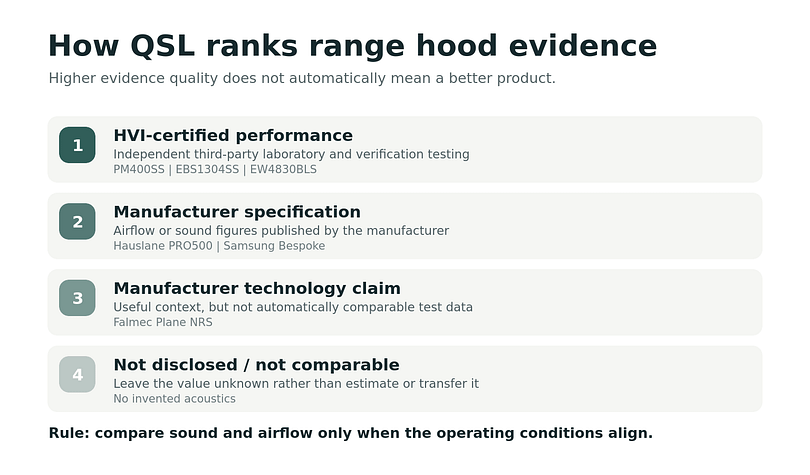
For range hoods, sound also needs context. A low-speed or normal-speed sound figure must not be presented as though it was measured at maximum airflow unless the documentation explicitly says so. The same rule applies to airflow: a “maximum,” “equivalent” or boost-mode number is not automatically the airflow you will experience at the operating point associated with the published sound figure.
1. Broan PM400SS — best quiet built-in insert
The PM400SS is the strongest starting point for buyers who want a custom built-in look and relatively strong evidence behind the performance figures. Broan lists the insert at 450 Max Blower CFM and 1 sone at normal speed, with HVI certification.
It is a three-speed insert rather than a decorative wall chimney hood. That makes it especially relevant when the cabinetry or hood surround is part of the kitchen design. It also supports multiple duct configurations and Broan lists optional recirculation equipment where exterior ducting is not possible.
Why it stands out: the combination of a low normal-speed sound figure, meaningful airflow and certified data is stronger evidence than simply describing a product as “ultra quiet.”
Watch for: 1 sone is the documented normal-speed figure. It should not be interpreted as the sound level at the hood’s maximum 450-CFM condition unless a speed-specific test establishes that relationship.
Evidence: Broan PM400SS manufacturer specifications.
Search Amazon for Broan PM400SS.
2. Broan EBS1304SS — best quiet slide-out range hood
The EBS1304SS takes a different approach. Its slide-out format is useful when the hood needs to disappear visually beneath cabinetry when it is not in use. Broan lists 400 CFM and quiet operation at 1.2 sones on normal speed, again with HVI certification.
The hood has three fan speeds, a six-inch round duct connection and a delay-off function. For a kitchen where cabinetry and visual simplicity matter as much as connected-home features, this is a more relevant comparison than a large chimney hood.
Why it stands out: it gives us a genuinely different installation type while preserving a relatively strong certified sound-and-airflow evidence base.
Evidence: Broan EBS1304SS manufacturer specifications.
Search Amazon for Broan EBS1304SS.
3. Broan EW4830BLS — best current wall-mounted option
The EW4830BLS is Broan’s current 30-inch pyramidal chimney option in black stainless steel. Broan lists 460 Max Blower CFM, HVI certification, 1.5 sones at normal speed and 7.5 sones on high.
This is useful evidence because it shows why a single sound figure can be misleading. The same hood is much quieter at its documented normal operating point than at high speed, so a buyer should not treat “1.5 sones” as though it describes every airflow setting.
Why it stands out: it gives us a current wall-mounted model with speed-specific sound context and HVI-certified performance rather than relying on a discontinued higher-airflow predecessor.
Evidence: Broan EW4830BLS manufacturer specifications.
Search Amazon for Broan EW4830BLS.
4. Hauslane PRO500 — best high-airflow under-cabinet choice
Hauslane’s PRO500 is useful because the manufacturer publishes more than one airflow figure. It lists 550 laboratory CFM alongside a 1,000-CFM “equivalent airflow” figure and a sound range of 1.5 to 6.0 sones.
Those figures should not be collapsed into a single headline claim. For comparison purposes, the laboratory airflow is the more conservative reference point, while the 1,000-CFM figure should remain explicitly labelled as Hauslane’s equivalent-airflow specification.
The hood uses a seven-inch round duct and four operating levels. It is therefore a useful option for buyers prioritizing stronger extraction who still want disclosed sound information.
Why it stands out: it demonstrates why QSL separates laboratory, equivalent and maximum airflow language instead of putting every number into one CFM column without context.
Evidence: Hauslane PRO500 manufacturer specifications.
Check Hauslane PRO500 on Amazon.
5. Samsung Bespoke NK30CB700WCGAA — best smart range hood
Samsung’s Bespoke smart wall-mount hood is the most clearly connected-home-oriented model in this shortlist. Samsung lists ventilation up to 630 CFM, SmartThings support and a Triple Air Sensor that can adjust operation based on detected kitchen air conditions.
For a smart-home buyer, those capabilities are more meaningful than adding an app merely to turn the fan on and off. Automation tied to actual air conditions is a legitimate functional difference.
Samsung also markets the hood as low noise, but we are not assigning it a comparable sone position in this guide because the current evidence used for this comparison does not provide a directly comparable sone figure alongside the other products.
Why it stands out: genuine connected-home functionality and air-sensing automation.
Watch for: smart features do not compensate for incorrect hood sizing or poor duct design.
Evidence: Samsung NK30CB700WCGAA manufacturer specifications.
Search Amazon for Samsung NK30CB700WCGAA.
6. Falmec Plane NRS — best premium noise-engineering option
Falmec takes a different route with its Noise Reduction System, or NRS. The current US Plane NRS variant is listed at 600 CFM and uses Falmec’s noise-reduction design, perimeter suction and electronic controls.
This makes it interesting for a premium kitchen where sound quality and design are central buying concerns. However, NRS is a manufacturer technology claim and should not automatically be converted into a sone ranking against HVI-certified models when the measurement basis is different.
Why it stands out: noise reduction is treated as an engineering objective rather than simply a marketing adjective.
Evidence: Falmec Plane NRS manufacturer specifications.
Search Amazon for Falmec Plane NRS.
What do sones actually tell you?
Sones describe perceived loudness rather than airflow. Lower is quieter, but a sone figure is only useful when you know the operating condition at which it was measured.
A range hood that is exceptionally quiet on its lowest setting may still become conspicuous at maximum airflow. Conversely, a stronger hood running at a moderate speed can sometimes be more comfortable in everyday use than an undersized hood that has to run at full power whenever you cook.
That is why our comparisons keep sound and airflow evidence separate instead of calculating a simplistic “quietness score.”
CFM vs noise: do not buy the biggest number
More airflow can be useful, especially for high-output cooking, but the hood is only one part of the ventilation system. Duct diameter, duct length, elbows, restrictions and the route to the exterior all affect the final result.
A poorly designed duct can increase resistance and turbulence. That can reduce delivered airflow and increase the noise you hear even when the hood itself performed well in a controlled test.
The practical goal is therefore not the highest possible CFM. It is enough verified airflow for the cooking setup, delivered through an appropriately designed duct system at a noise level you are comfortable living with.
Ducted vs ductless range hoods
A ducted hood removes captured cooking contaminants to the outside. A recirculating or ductless configuration filters the air and returns it to the room.
Those are not equivalent ventilation outcomes. Recirculation can be useful where exterior ducting is impossible, but buyers should check exactly which filters and conversion kits are required and what contaminants the system is designed to capture.
If quiet operation is a priority, also remember that adding resistance to the airflow path can change the acoustic result. Installation quality matters.
Which smart features actually matter?
Smart-home control is useful when it changes how the ventilation system behaves rather than simply duplicating a physical button on a phone.
Features worth examining include automatic air-quality response, automatic operation with a compatible cooktop, useful delay-off control, filter reminders and integrations that can operate locally or reliably without turning the hood into an app-dependent appliance.
We would not choose a noisier or poorly sized hood merely because it has Wi-Fi.
Range hoods and indoor air quality
A range hood performs source capture: it tackles cooking pollutants where they are produced. That is a different job from a room air purifier. A purifier can play a useful secondary role for airborne particles and other pollutants, but it is not a substitute for properly designed kitchen exhaust ventilation.
For broader connected-home filtration options, see our guide to smart air purifiers.
Our current recommendations
For the strongest evidence-led quiet insert: Broan PM400SS.
For a discreet slide-out installation: Broan EBS1304SS.
For a current HVI-certified wall mount: Broan EW4830BLS.
For high airflow with clearly disclosed manufacturer noise data: Hauslane PRO500.
For connected-home features: Samsung Bespoke NK30CB700WCGAA.
For a premium noise-reduction design: Falmec Plane NRS.
The right choice still depends on the cooktop, hood width, duct route, installation constraints and the operating speed you will actually use most often.
Frequently asked questions
How many sones is considered quiet for a range hood?
There is no useful universal cutoff without knowing the operating speed. Around 1 to 1.5 sones at a documented normal operating point is comparatively quiet, but always check what airflow condition the sound figure represents.
Is a 600 CFM range hood louder than a 300 CFM hood?
Not necessarily. Airflow capacity alone does not determine noise. Blower design, operating speed, hood geometry and the installed duct system all affect the result.
Should I buy the range hood with the lowest sone rating?
Not if it cannot provide enough ventilation for your cooking setup. Sound and airflow need to be considered together.
Are ductless range hoods quieter?
Not automatically. Recirculating systems change the airflow path and add filters, and their acoustic performance varies by model and installation.
Are smart range hoods worth it?
They can be when automation solves a real problem, such as responding to air conditions, coordinating with a compatible cooktop or providing useful filter and operating controls. Connectivity alone is not a reason to choose a hood.
Does duct size affect range hood noise?
Yes. Restrictive or poorly routed ductwork can increase resistance and turbulence, reducing real airflow and potentially increasing noise.
Bottom line
The best quiet range hood is not simply the model with the lowest advertised sound number. Look for credible airflow and sound evidence, make sure both figures are interpreted at the correct operating condition, and treat duct design as part of the product rather than an afterthought.
That evidence-first approach is also why some products in this guide carry certified performance data while others remain clearly labelled as manufacturer-reported or technology-based claims.